The science of biology says that an individual human
life begins at fertilization (conception) and is continuous, either in the womb
or out, until natural death. Starting as a one-celled organism called a
zygote, each human life goes through a series of stages:
- Pre-Embryonic Stage: From fertilization to 20
days of gestation.
Cell division takes place rapidly and elementary body systems are
formed. The heart starts beating as early as 18 days.
- Embryonic Stage: From 3-8 weeks.
At 3 weeks the baby's arms, legs, eyes, and ears start to form.
Brain waves can be detected and measured as early as 6 weeks, and at 8 weeks
the heartbeat can be heard with an electronic stethoscope, seen on an
ultrasound screen, and recorded in an electrocardiogram.
The 8-week-old baby responds to touch, sucks his thumb, and grasps an object
contacting his hand. He has sleeping and waking periods, is active,
and moves about in the amniotic sac.
- Fetal stage: From 8-39 weeks.
The term fetus is a Latin work meaning "little one."
At 10-11 weeks the baby's body is completely formed, including the
fingerprints he will
take with him for the rest of his life. At 12-13 weeks no new
organs or body systems form.
Except for size and weight, the baby is essentially complete.
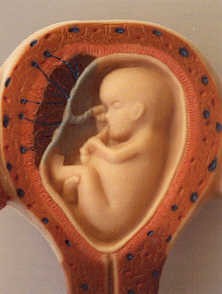
A perfect little 12 week old human being
is nestled in his mother's uterus.
(Note: The picture here may appear larger than life size.)
|